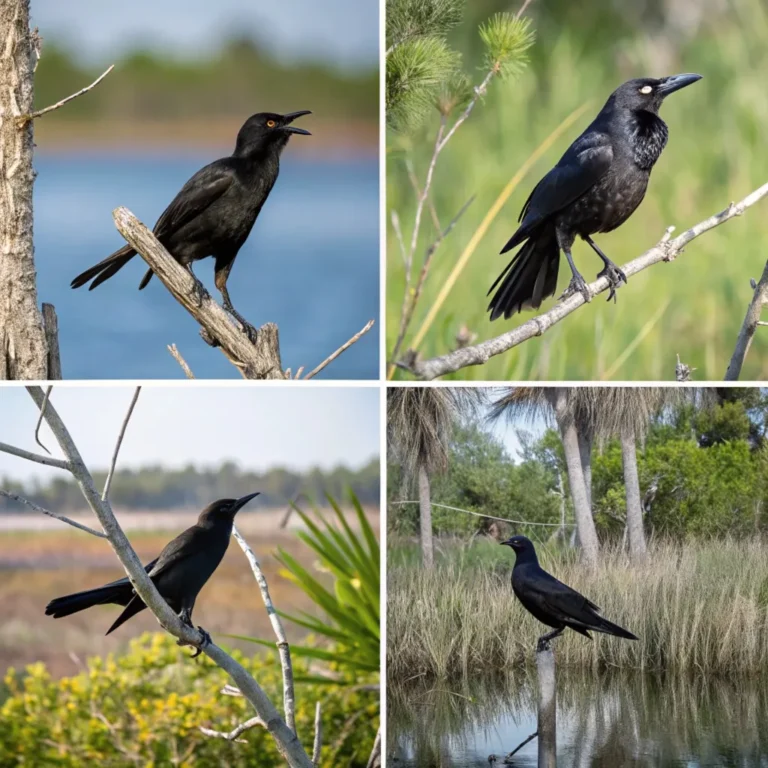

Grackles: Are They Truly Smart Birds? Unraveling Their Intelligence
Grackles, often seen as noisy backyard visitors, are more than meets the eye. These clever birds possess a level of intelligence that surprises many researchers and bird enthusiasts alike.
This article delves into the fascinating world of grackle cognition, exploring their problem-solving skills, social intelligence, and adaptive behaviors.
We’ll uncover the latest research findings and expert insights that reveal just how smart these birds really are.

Key Takeaways: Grackle Intelligence in a Nutshell
- Grackles exhibit impressive problem-solving abilities, adapting their foraging strategies to various environments.
- They demonstrate behavioral flexibility, quickly learning to change their preferences when faced with new situations.
- Grackles use complex communication skills, including specific alarm calls to warn flock members of potential threats.
- Their social behavior is highly developed, with large flocks working together for protection and food-finding.
- While intelligent, grackles may not match the cognitive abilities of some other bird species like crows or parrots.
- Individual variation exists in grackle intelligence, with some birds showing more flexibility in certain tasks than others.
- Grackles can use basic tools and have been observed employing creative methods to access food.
- Their adaptability to urban environments showcases their cognitive prowess and ability to thrive in changing conditions.
- Research suggests that problem-solving efficiency may not directly correlate with behavioral flexibility in grackles.
- The study of grackle intelligence offers valuable insights into avian cognition and adaptive behaviors.
Understanding Grackle Intelligence
Grackles possess a unique blend of cognitive abilities that enable them to thrive in diverse environments. Their intelligence manifests in various ways, from problem-solving to social interactions.
The cognitive prowess of grackles is evident in their daily behaviors and interactions with their environment. These birds demonstrate a remarkable ability to assess situations quickly and make decisions that benefit their survival.
Their intelligence is not just limited to individual problem-solving but extends to social learning and cultural transmission within their flocks.
Grackles have been observed passing on learned behaviors to other members of their group, indicating a level of social cognition that is crucial for their collective success.
Research into grackle intelligence has revealed fascinating insights into their mental capabilities. Studies have shown that these birds possess a degree of self-awareness, as demonstrated by their responses to mirror tests.
While not as advanced as some primates or dolphins, this self-awareness suggests a higher level of cognitive function than previously thought.
Additionally, grackles exhibit metacognition, the ability to reflect on their own thought processes, which is considered a hallmark of advanced intelligence in animals.
Problem-Solving Prowess

Grackles demonstrate remarkable problem-solving skills in their daily lives. They adapt their foraging strategies based on available resources, switching between insect hunting, seed eating, and even scavenging.
This flexibility in food acquisition showcases their ability to assess situations and find optimal solutions.
The problem-solving abilities of grackles extend beyond simple food acquisition. These birds have been observed using innovative techniques to access hard-to-reach food sources.
For instance, they have been seen dropping nuts onto roads, waiting for cars to crack them open, and then retrieving the exposed kernels during traffic stops.
This behavior demonstrates not only problem-solving skills but also an understanding of cause and effect, as well as the ability to time their actions precisely.
Grackles also show remarkable adaptability in their problem-solving approaches. When faced with new challenges, they often employ a trial-and-error method, quickly learning from their mistakes and refining their strategies.
This ability to learn and adapt on the fly is a key component of their intelligence, allowing them to thrive in a variety of environments, from rural areas to bustling urban centers.
Tool Use and Creativity
While not as renowned for tool use as some other bird species, grackles have shown the ability to use basic tools.
They have been observed using sticks to probe for insects and dropping nuts on hard surfaces to crack them open. These behaviors indicate a level of cognitive sophistication not commonly associated with these birds.
The creative problem-solving abilities of grackles are particularly evident in their foraging behaviors. These birds have been observed using a variety of unconventional methods to access food sources that would otherwise be out of reach.
For example, some grackles have been seen using small twigs or pieces of grass to probe into crevices and extract insects.
This behavior, while not as advanced as the tool use seen in some corvids, still demonstrates a level of cognitive flexibility and creativity that is impressive for their species.
Moreover, grackles have shown an ability to improvise tools when necessary. In urban environments, they have been observed using human-made objects in novel ways to achieve their goals.
For instance, some grackles have been seen using discarded pieces of plastic or paper to carry water back to their nests, a behavior that requires both creativity and an understanding of object properties.
This adaptability in tool use further underscores the grackle’s intelligence and problem-solving capabilities.
Social Intelligence

Grackles are highly social birds, often forming large flocks. This social structure requires complex communication and cooperation. They use various vocalizations to convey messages within the flock, including specific alarm calls to warn of potential predators.
The social intelligence of grackles is evident in their complex flock dynamics. These birds demonstrate a remarkable ability to coordinate their movements and behaviors within large groups.
This coordination is not just about flying in formation; it extends to foraging strategies, predator avoidance, and even conflict resolution within the flock.
Grackles have been observed engaging in sophisticated social behaviors, such as reciprocal grooming and food sharing, which indicate a high level of social cognition and cooperation.
Furthermore, grackles exhibit social learning capabilities that contribute to their collective intelligence. Young grackles learn important survival skills by observing and imitating older, more experienced members of the flock.
This ability to learn from others allows for the rapid spread of beneficial behaviors throughout the population.
It also enables grackles to quickly adapt to new environments or food sources, as innovative solutions discovered by one individual can be quickly adopted by the entire group.
Behavioral Flexibility
One of the most impressive aspects of grackle intelligence is their behavioral flexibility. Studies have shown that grackles can quickly adapt to new situations, changing their preferences when circumstances change. This ability is crucial for their survival in rapidly changing environments.
The adaptability of grackles is particularly evident in their response to environmental changes. These birds have shown a remarkable ability to adjust their behaviors in response to both natural and human-induced alterations in their habitat.
For example, in urban areas where traditional food sources may be scarce, grackles have been observed developing new foraging strategies, such as scavenging from human refuse or learning to open food packaging.
This flexibility allows them to thrive in a wide range of environments, from rural farmlands to bustling city centers.
Research has also revealed that grackles possess a high degree of cognitive flexibility. In experimental settings, these birds have demonstrated the ability to quickly learn and unlearn associations, adapting their behavior based on changing reward patterns.
This cognitive flexibility is crucial for survival in dynamic environments where food availability and predator presence can change rapidly.
It also suggests that grackles have a sophisticated understanding of cause-and-effect relationships, allowing them to make informed decisions in complex situations.
Comparative Intelligence
When compared to other bird species, grackles hold their own in terms of cognitive abilities. While they may not match the problem-solving skills of crows or the linguistic capabilities of parrots, grackles demonstrate a level of intelligence that is often underestimated.
In the avian intelligence hierarchy, grackles occupy a unique position. While they may not reach the cognitive heights of some corvids like ravens or New Caledonian crows, they consistently demonstrate impressive problem-solving abilities and social intelligence.
Grackles excel in areas such as behavioral flexibility and adaptability, often surpassing other bird species in these domains. Their ability to thrive in diverse environments, from rural to urban settings, is a testament to their cognitive capabilities and adaptability.
Comparative studies have shown that grackles perform remarkably well in certain cognitive tasks. For instance, in tests of behavioral flexibility, grackles have sometimes outperformed other bird species known for their intelligence.
Their performance in tasks involving learning and memory is also noteworthy, often matching or exceeding that of other intelligent bird species.
These findings challenge the traditional view of avian intelligence and highlight the importance of considering a wide range of cognitive abilities when assessing bird intelligence.
Urban Adaptation
Grackles have successfully adapted to urban environments, showcasing their cognitive abilities. They have learned to navigate human-made structures, find food in unlikely places, and even open trash bins to access food. This adaptability is a testament to their intelligence and problem-solving skills.
The urban adaptation of grackles is a prime example of their cognitive flexibility and problem-solving abilities. In cities, these birds have demonstrated an impressive capacity to exploit new food sources and nesting opportunities.
They have been observed using traffic patterns to their advantage, such as using moving vehicles to crack open nuts placed on roads. This behavior not only shows problem-solving skills but also an understanding of cause and effect and the ability to time actions precisely.
Grackles have also shown remarkable learning abilities in urban settings. They quickly learn to associate certain human behaviors or locations with food availability.
For instance, they have been observed following garbage trucks or congregating in areas where people frequently feed birds.
This ability to rapidly learn and exploit new opportunities in a complex, human-dominated environment is a clear indicator of their intelligence and adaptability.
Research Insights
Scientific studies have provided valuable insights into grackle intelligence. Experiments have shown that grackles can solve complex problems, such as the Aesop’s Fable test, where they must drop objects into water to raise the level and access floating food.
Recent research findings have shed light on the cognitive capabilities of grackles, revealing surprising depths to their intelligence.
One notable study demonstrated that grackles possess a level of causal understanding comparable to that of some primate species.
In experiments involving tool use and problem-solving, grackles showed an ability to grasp the underlying principles of tasks, rather than simply learning through trial and error. This suggests a more sophisticated cognitive process at work, one that involves reasoning and inference.
Another fascinating area of research has focused on the social learning abilities of grackles. Studies have shown that these birds are capable of learning new behaviors not only from direct experience but also by observing their fellow grackles.
This ability to learn from others is a key component of cultural transmission within bird populations and is considered a hallmark of higher cognitive function.
The research suggests that grackles may have a more complex social structure and learning system than previously thought, contributing to their success in diverse environments.
Individual Variation
Research has revealed that there is significant individual variation in grackle intelligence. Some grackles perform better on certain tasks than others, suggesting that intelligence in these birds is not uniform across the species.
The individual differences observed in grackle intelligence provide fascinating insights into the nature of cognition in these birds.
Studies have shown that some grackles consistently outperform others in problem-solving tasks, displaying higher levels of cognitive flexibility and innovation.
This variation is not just limited to problem-solving abilities but extends to other aspects of intelligence, such as social learning and memory. These individual differences suggest that, like humans, grackles may have distinct cognitive strengths and weaknesses.
Researchers have also noted that the variation in intelligence among grackles appears to be influenced by both genetic and environmental factors.
Some studies have suggested that certain cognitive traits may be heritable, while others are more strongly influenced by early life experiences and learning opportunities.
This interplay between nature and nurture in shaping grackle intelligence mirrors what we see in many other intelligent species, including humans, and provides valuable insights into the evolution of cognitive abilities in birds.
Learning and Memory
Grackles demonstrate impressive learning and memory capabilities. They can remember food sources, recognize individual humans, and learn from each other’s behaviors. This cognitive flexibility allows them to adapt quickly to new challenges.
The learning abilities of grackles are particularly noteworthy. These birds have shown a remarkable capacity for rapid learning, quickly picking up new skills and behaviors when faced with novel situations.
In experimental settings, grackles have demonstrated the ability to learn complex sequences of actions to obtain rewards, often mastering these tasks faster than many other bird species.
This rapid learning is crucial for their survival in changing environments, allowing them to quickly adapt to new food sources or avoid new threats.
Grackles also possess impressive memory capabilities. They have been observed remembering the locations of food sources over extended periods, even when these sources are only available seasonally.
Additionally, grackles have shown the ability to recognize and remember individual human faces, a skill that can be beneficial in urban environments where interactions with humans are frequent.
This combination of quick learning and strong memory contributes significantly to the grackle’s success in diverse habitats.
Communication Skills
The vocal repertoire of grackles is extensive, indicating a sophisticated communication system. They use different calls for various purposes, from attracting mates to coordinating group movements, showcasing their social intelligence.
The communication system of grackles is remarkably complex and nuanced. These birds employ a wide range of vocalizations, each serving a specific purpose in their social interactions.
For instance, they have distinct alarm calls that not only alert other grackles to the presence of predators but also convey information about the type and location of the threat.
This level of specificity in their alarm calls suggests a sophisticated understanding of their environment and the ability to categorize different types of dangers.
Grackles also use non-vocal communication methods to convey information. Their body language, including postures and movements, plays a crucial role in their social interactions.
For example, during courtship displays, male grackles use a combination of vocalizations and physical displays to attract females. These displays often involve complex sequences of movements and calls, demonstrating the grackle’s ability to integrate multiple forms of communication.
The complexity of their communication system reflects the social intelligence of these birds and their ability to convey detailed information to their flock mates.
Problem-Solving Strategies
Grackles employ various strategies when solving problems. They have been observed using trial and error, observational learning, and even innovative approaches to overcome obstacles and access food.
The problem-solving approaches of grackles demonstrate a remarkable level of cognitive flexibility. When faced with a new challenge, grackles often employ a systematic approach, starting with simple strategies and progressively trying more complex solutions.
This methodical problem-solving behavior suggests a level of planning and foresight that is impressive for a bird species.
For instance, when presented with a puzzle feeder in experimental settings, grackles have been observed trying different techniques, learning from their failures, and refining their approach until they succeed.
Grackles also show a strong tendency towards social learning in their problem-solving strategies. They often observe the actions of their flock mates and learn from successful individuals.
This ability to learn from others allows for the rapid spread of effective problem-solving techniques throughout a grackle population. Moreover, grackles have demonstrated the ability to innovate new solutions when faced with unique challenges.
This innovative capacity, combined with their observational learning skills, enables grackles to adapt quickly to new environments and food sources, contributing to their success as a species.
Cognitive Limitations
While intelligent, grackles do have cognitive limitations. They may not perform as well as some other bird species on certain complex tasks, and their problem-solving abilities can vary depending on the context.
Despite their impressive cognitive abilities, grackles do face certain limitations in their intelligence. One area where they may fall short compared to some other bird species is in abstract reasoning.
While grackles excel at practical problem-solving related to their immediate needs, they may struggle with tasks that require a higher level of abstraction or symbolic thinking.
For example, in experiments involving the use of symbolic representations to solve problems, grackles typically do not perform as well as some corvid species like crows or ravens.
Another limitation observed in grackle cognition is their performance consistency across different types of tasks.
While they may excel in certain areas, such as behavioral flexibility and social learning, their performance can be more variable in other cognitive domains.
This variability suggests that grackle intelligence is specialized, having evolved to meet the specific challenges of their ecological niche.
It’s important to note that these limitations do not diminish the overall intelligence of grackles but rather highlight the specialized nature of their cognitive abilities.
Implications for Avian Cognition
The study of grackle intelligence has broader implications for our understanding of avian cognition. It challenges preconceptions about bird intelligence and highlights the diverse ways in which cognitive abilities can manifest in different species.
Research into grackle intelligence has significant implications for our understanding of avian cognition as a whole.
The cognitive abilities demonstrated by grackles challenge the traditional view that advanced intelligence in birds is limited to a few select species like corvids and parrots.
The behavioral flexibility and problem-solving skills of grackles suggest that complex cognitive abilities may be more widespread in the avian world than previously thought.
This realization prompts a reevaluation of how we assess and categorize intelligence across different bird species.
Moreover, the study of grackle cognition provides valuable insights into the evolution of intelligence in birds.
The adaptive nature of grackle intelligence, particularly their ability to thrive in diverse and changing environments, offers clues about the selective pressures that may have driven the development of cognitive abilities in birds.
This research also highlights the importance of considering a species’ ecological niche and social structure when evaluating its cognitive capabilities, suggesting a more nuanced approach to understanding avian intelligence.
Future Research Directions
There is still much to learn about grackle intelligence. Future research could focus on comparing grackle cognition across different populations, investigating the role of genetics in their cognitive abilities, and exploring how their intelligence adapts to changing environmental conditions.
The ongoing research into grackle intelligence opens up exciting avenues for future studies. One promising direction is to compare cognitive abilities across different grackle populations throughout their expanding range.
Dr. Corina Logan, a researcher at the University of Cambridge, is seeking grants to investigate variations between grackle populations across North and Central America.
This research aims to understand how factors such as length of stay in a particular area, nutritional status, and genetics might influence the adaptive capabilities of different populations.
Another intriguing area for future research is exploring how grackles’ cognitive flexibility varies in different contexts. Dr. Logan is particularly interested in understanding “how behavioral flexibility works and why it differs according to the type of problem being solved.”
This line of inquiry could provide valuable insights into the adaptive nature of grackle intelligence and how it contributes to their successful range expansion.
Implications for Conservation and Ecology
Understanding grackle intelligence has broader implications for conservation efforts and our understanding of ecological adaptations. The insights gained from studying these adaptable birds could be applied to helping endangered species survive in changing environments.
The remarkable adaptability of grackles to urban environments offers valuable lessons for conservation efforts.
As Dr. Kelsey McCune from Arizona State University points out, studying grackles’ ability to thrive among humans could help conservationists in their efforts to reintroduce endangered species into the wild.
By understanding how grackles adapt to new environments, researchers can potentially apply similar strategies to help other species survive and thrive when released from captivity breeding programs.
Moreover, the study of grackle intelligence provides insights into the evolution of cognitive abilities in birds.
As Dr. Kevin Langergraber from Arizona State University suggests, learning how grackles have successfully pushed into new areas has implications for the study of human history and the adaptive strategies that allow species to expand their ranges.
Interdisciplinary Applications
Research into grackle intelligence has potential applications beyond ecology and conservation, extending into fields such as medicine, psychology, and even artificial intelligence.
The interdisciplinary nature of grackle research offers exciting possibilities for applications in various fields. For instance, the study of grackle cognition and behavior could provide insights into human cognitive processes and adaptive strategies.
As Michael Pickett, a student researcher on the Grackle Project, notes, the biological aspects of grackle research, such as genetic analysis and health testing, have relevance to biomedical research.
Furthermore, the study of grackle intelligence and behavioral flexibility could inform the development of adaptive algorithms in artificial intelligence. The ways in which grackles learn to navigate new environments and solve novel problems could inspire more flexible and adaptable AI systems.
In conclusion, the study of grackle intelligence not only sheds light on the cognitive abilities of these fascinating birds but also offers valuable insights into broader questions of animal cognition, ecological adaptation, and the evolution of intelligence.
As research in this field continues to evolve, it promises to yield exciting discoveries with far-reaching implications across multiple disciplines.
FAQs
How smart are grackles compared to other birds?
Grackles are intelligent birds that demonstrate problem-solving skills and behavioral flexibility. While they may not match the cognitive abilities of some highly intelligent bird species like crows or parrots, they show impressive adaptability and learning capabilities.
Can grackles use tools?
Grackles have been observed using basic tools, such as sticks to probe for insects or dropping nuts on hard surfaces to crack them open. While not as sophisticated as some other tool-using birds, this behavior indicates a level of cognitive ability.
Do grackles have good memory?
Yes, grackles demonstrate good memory skills. They can remember food sources, recognize individual humans, and learn from past experiences, which helps them adapt to various environments.
How do grackles communicate with each other?
Grackles have a complex communication system that includes various vocalizations. They use specific calls for different purposes, such as warning about predators, attracting mates, or coordinating group movements.
Are grackles social birds?
Yes, grackles are highly social birds. They often form large flocks, especially outside of breeding season, which helps them in finding food and protection from predators.
Can grackles solve complex problems?
Grackles have shown the ability to solve complex problems in experimental settings, such as the Aesop’s Fable test. However, their problem-solving abilities can vary among individuals and depending on the task.
How do grackles adapt to urban environments?
Grackles are highly adaptable to urban environments. They learn to navigate human-made structures, find food in unlikely places, and even open trash bins, showcasing their cognitive flexibility and problem-solving skills.
Is there variation in intelligence among individual grackles?
Yes, research has shown significant individual variation in grackle intelligence. Some grackles perform better on certain tasks than others, indicating that cognitive abilities can differ within the species.
How does grackle intelligence compare to human intelligence?
While grackles are intelligent birds, their cognitive abilities are not comparable to human intelligence. They excel in areas relevant to their survival and adaptation but lack the complex reasoning and abstract thinking capabilities of humans.
What can studying grackle intelligence tell us about bird cognition in general?
Studying grackle intelligence provides valuable insights into avian cognition, challenging preconceptions about bird intelligence and highlighting the diverse ways cognitive abilities can manifest in different species. It helps us understand how birds adapt to changing environments and solve problems in their daily lives.

Joyce is the passionate founder of Chirping Hearts, a website dedicated to sharing her love for birds and providing valuable information about avian life. With a background in ornithology and years of experience in birdwatching, Joyce aims to inspire others to appreciate the beauty and diversity of birds. Through her engaging articles and guides, she hopes to foster a community of bird enthusiasts who share her enthusiasm for these incredible creatures. When she’s not writing, Joyce enjoys exploring nature trails and observing birds in their natural habitats.